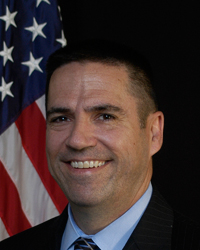
Feb. 19: Michele Leonhardt, Administrator, DEA, DOJ

Join us February 19 to hear from

Michele LeonhardtMichele Leonhardt
Administrator
U.S. Drug Enforcement Agency
U.S. Department of Justice

10:00 am – 12:00pm
REGISTER
Administrator Leonhardt will discuss the DEA’s mission, priorities and challenges for 2014.

About Michele Leonhardt
Michele M. Leonhart was unanimously confirmed as the Administrator of the Drug Enforcement Administration by the U.S. Senate on December 22, 2010, following her nomination by President Obama in February 2010. In that capacity, Ms. Leonhart, a career DEA Special Agent, directs the $3 billion agency and is responsible for over 10,000 employees in domestic offices throughout the U.S. and in 86 foreign offices in 67 countries. Ms. Leonhart had been the Acting Administrator since November 2007, and served as DEA’s Deputy Administrator since 2004.

Prior to becoming Administrator and Deputy Administrator, Ms. Leonhart held several positions within DEA’s Senior Executive Service (SES). She was the Special Agent in Charge of DEA’s Los Angeles Field Division from 1998-2003. In that capacity, she commanded one of DEA’s largest Field Divisions and was responsible for all enforcement and administrative operations in the Los Angeles area, as well as Nevada, Hawaii, Guam and Saipan. She previously held the position of Special Agent in Charge of DEA’s San Francisco Field Division from 1997-1998, becoming DEA’s first female ever to be promoted to the position of Special Agent in Charge. Ms. Leonhart’s first appointment within the SES was in 1996 when she spearheaded DEA’s Special Agent Recruitment efforts at DEA Headquarters.

As a career DEA Special Agent, Ms. Leonhart held several key positions as she moved through the ranks of DEA. In 1995 she was promoted to the position of Assistant Special Agent in Charge of the Los Angeles Field Division, responsible for Southwest Border enforcement operations and division administrative functions. Between 1993 and 1995, Ms. Leonhart held management positions within DEA Headquarters to include Career Board Executive Secretary, Office of Professional Responsibility (OPR) Inspector, and Staff Coordinator in the Operations Division. Ms. Leonhart’s first supervisory position was in DEA’s San Diego Field Division. Prior to that, Ms. Leonhart initiated major drug investigations and conspiracy cases in Minneapolis and St. Louis, and served as a DEA Special Agent recruiter.

While at DEA, she attended Boston University’s Leadership Institute, and is the recipient of numerous awards and commendations in recognition of her leadership, performance and commitment to public service. She was awarded the rank of Distinguished Executive by President Bush in 2004, the Presidential Rank Award for Meritorious Service from President Bush in 2005, and the Presidential Rank Award for Meritorious Service from President Clinton in 2000. Additionally, Administrator Leonhart received the Law Enforcement Exploring William H. Spurgeon Award in 2006, the Women in Federal Law Enforcement Outstanding Federal Law Enforcement Employee Award in 2005, and the Administrator’s Award in 1993.

Ms. Leonhart has more than 30 years in law enforcement, beginning her law enforcement career as a Baltimore City Police Officer after graduating from college in Minnesota with a B.S. degree in Criminal Justice in 1978. She joined the ranks of DEA as a Special Agent in 1980. A native of Minnesota, Ms. Leonhart is married and has two sons.

GTSC Awards February 5 NEW VENUE

REGISTER today to join us for the GTSC Awards Celebration!


Join the Government Technology & Services Coalition for an extraordinary celebration of some heroes of 2013 at our Annual Awards Celebration! We’re thrilled to feature our Italian Feast dinner buffet in addition to holiday libations, great company and a fun evening to recognize the accomplishments of those working to achieve the mission of securing our homeland.

NEW VENUE: U.S. Navy Memorial, 701 Pennsylavania Avenue NW, Washington, D.C.
Navy Memorial Metro

The 2013 GTSC Holiday Awards honors:

Federal Small Business Champions of the Year Award:
John Morton, former Director, U.S. Immigration and Customs Enforcement & Jonathan Porter, Chief of Staff, U.S. Immigration and Customs Enforcement

Federal Small Business Champion of the Year is awarded annually to the Federal official(s) who show a distinct commitment and tangible results toward improving the environment and success for small businesses in the Federal homeland and national security market.

john porter ice

Jonathan Fantini Porter
Chief of Staff, Management & Administration
U.S. Immigration & Custos Enforcement

Market Maven of the Year Award: Chad C. Sweet, Co-Founder & CEO, The Chertoff Group

Normally presented at the GTSC Anniversary, 2013 year’s Market Maven of the Year Award will be presented at the holiday party. It is presented to an exceptional individual who contributes in a concrete and tangible way to the efficiency, productivity and effectiveness of the homeland and national security market. Proven as a thought leader with a belief in increasing individual opportunity, the power of free enterprise and the nurture of innovation to advance and support the homeland and national security mission.


Strategic Partner of the Year Award: Brian E. Finch, Partner, Global Security Practice, Dickstein Shapiro LLP
The Strategic Partner of the Year is awarded annually to the Strategic Partner that demonstrates a clear commitment to GTSC, contributes significantly to the content and substance of the organization and provides GTSC members with counsel, insight and resources to perform exceptionally on behalf of the homeland and national security mission.


Strategic Advisor of the Year Award: Bill Carroll, Senior Partner, Strike Force Consulting

The Strategic Advisor of the Year is awarded annually to the Strategic Advisor who works on behalf of GTSC to increase our capacity, membership and opportunities to bring the innovation, creativity and solutions of small and mid-sized companies to the homeland and national security mission.


Small Business Member of the Year Award: PReSafe Technologies LLC

The award is presented annually to the GTSC Member that exemplifies exceptional quality and ethics for the Federal government, a commitment to GTSC’s small business members and advocacy on behalf of our community.


Mentor of the Year Award: TASC & Mike Kelly, Vice President, Business Development, Civil and Infrastructure Security Group, TASC
Mentor of the Year is awarded annually to the GTSC Mentor who has worked to increase members’ understanding of the homeland and national security market, increased business opportunities for small companies through formal and informal mentoring and engages with GTSC to promote an innovative, robust, fair market for all.

About our Charity Partner:  The Border Patrol Foundation

The Border Patrol Foundation provides resources to the families of the fallen and creates awareness of the escalating risk of those who keep America’s borders safe. These services create a financial bridge through the turbulent time following a family’s loss. The Foundation supports programs improving awareness of United States border security and recognizes community leaders supporting the families of the U.S. Border Patrol. The Foundation’s volunteers have served with the U.S. Border Patrol or are professionals, friends and family committed to the importance of securing America’s borders and dedicate their lives to the same.

Thank You to our Sponsors!

Gold Sponsors


Silver Sponsors

chertoff logo final

Thank you for support from IBM, Old Dominion Strategies and Strativest!


Support and sponsorships of our holiday event are welcome  — please contact us to help make this our best event ever!


Insider Threat Programs: 5 Easy Steps to Protect Your Company

The insider threat is a real concern across government and industry and unfortunately, we continue to see significant evidence of the damage incurred by malicious insiders, such as Snowden and Manning.  In the next few years, we will see changes to Government policy, including the National Industrial Security Program Operating Manual (NISPOM) to ensure we are properly protecting national security information and corporate assets.

Since the mere thought of how to create an insider threat plan can be overwhelming, the following five steps are intended to help you put things into perspective as you begin to develop and document your corporate plan.  There are many sources of information available for companies to reference (see list of sources).

Step 1:  Identify the Team

Assemble a team who can make decisions, change policies and understand the importance of the issues.  It is critical the team has a solid understanding of your overall business and your corporate assets.  You may want to include a member of executive management (COO) with budget authority as well as representatives from HR, Security, IT and your legal department.  Schedule a regular meeting time and assign someone on the team to take minutes.  An agenda can also be helpful as you begin to cover the elements of the plan.  The team needs to be able to work across the organization and have the synergy necessary to ensure that when a problem arises, it can be handled quickly.  The team should know the staff and be able to recognize concerning behaviors as potential indicators.

Step 2:  Conduct a Risk Assessment

One of the best ways to protect your company is to fully understand your assets and ensure you are taking the appropriate steps to secure them.  Sit down with executive management and outline what your corporate assets are, such as trade secrets, salary data, proposal data, proprietary data, sponsor or Government National Security data, strategic plans, Personally Identifiable Information (PII), and your IT systems and servers, etc.

Once you have established what the assets are, determine how well they are protected.  What is the risk if the information is leaked to a competitor or a foreign entity?  Look at who has access to the information.  You will want to take steps to limit vulnerability by controlling access to files by staff who do not need the information to complete their job function.  In addition, ascertain if someone terminates to go to a competitor, or for any reason, that you understand immediately what information the person has access to.  Ensure you have procedures in place to be able to take immediate steps to terminate access to information.

Determine if you want to hire consultants to conduct a risk assessment or if you prefer to handle the risk assessment with the senior staff in-house.  The benefit of utilizing consultants may be an unbiased result but may be cost prohibitive.  You might find that you would rather allocate funds to purchase new equipment, such as a new firewall, to protect the assets.

Step 3:  Tighten Up Procedures/Policies

Ideally, the insider threat team will work together to strengthen the procedures, gather feedback, implement changes, and document the new policies as part of the plan.

Start this step by looking at the procedures and policies currently in place to protect  the assets you identified during the risk assessment.  For example, if you have identified certain proposal data as proprietary, you should engage your IT staff to monitor who is downloading the data.  You can also tighten up the procedures surrounding the termination of employees to ensure they understand the NDA’s they signed.  This will protect your company’s assets.  If possible, at the first notification of a termination, look at what the employee has been accessing for the past 30 days.  At this time, remind the person of the NDA signed at date of hire.

In addition to tightening up procedures, adapt an Acceptable Use Policy for your company.  The purpose of an Acceptable Use Policy is to outline the proper use of company information systems.  The policy is established to protect the employee as well as your company from risks (including virus attacks, compromise of network systems and services, and legal issues) due to inappropriate use and/or malicious conduct.  Ensure your staff understands the Acceptable Use Policy and the sanctions associated when the policy is violated.

Step 4:  Security Education

Security education can be as creative as you are!  Many companies that contract with the Government have a security education program in place.  Supplementing the plan with insider threat material is easy with all the resources available online.  The goal of the security education program is to ensure your employees understand how to recognize a threat, both internal to the organization as well as from the outside (such as recruitment), the importance of reporting the potential threat, and how to file a report.

Encourage your staff to report and provide a confidential means of reporting.  If your staff is required to report adverse information, remind them of the requirement.  Reporting may lead to early detection of malicious insiders as well as possible recruitment.

Below are a few examples of indicators but please refer to the sources below for more detailed lists of threat indicators and observable behaviors that may indicate someone is involved in malicious activities.

  • Unexplained affluence or excessive indebtedness
  • Efforts to conceal foreign contacts, foreign travel or foreign interests
  • Requesting access to or accessing information outside official job duties including sensitive or classified information
  • Disgruntled behavior at work
  • Drug or alcohol abuse, excessive gambling, or criminal activity
  • Questionable judgment or untrustworthiness
  • Apparent mental, emotional or personality disorders
  • Working odd hours (suddenly changing working hours)
  • Printing or downloading files excessively

Here are a few ideas to introduce and begin to implement your insider threat program.  Add a few slides to your annual refresher training as a means of introducing the topic and outlining the requirements for reporting.  You can also add to or begin to publish a monthly newsletter to highlight threat indicators and reporting procedures.  Both DSS and the FBI websites have downloadable brochures with relevant information.  If you need a little humor, Threat Geek has great cartoons with insider threat content that will deliver your message in an entertaining way.

Step 5:  Document Your Plan

By the time you get to this step you should be well on your way toward creating a successful plan.  If you have maintained good notes along the way, it will be easy to put the results of your risk assessment, new policies and procedures you have implemented, the details of your security education program, and the team responsibilities into a corporate plan.

Remember, you are never done!  Insider threat is an ongoing and evolving issue and your plan should be continuously amended as you gain more experience working through various issues that arise.

Contributing Author:  Katherine D. Mills

Kathy Mills square

Katherine D. Mills is Chief Security Officer and Security Director for GTSC Member CENTRA Technology, Inc.   She has over 20 years experience in security and at CENTRA is responsible for all aspects of security operations under the company’s National Industrial Security Program, including personnel, program, physical, and information security, at both CENTRA’s Arlington and Burlington locations. 


Sources:

CERT: Common Sense Guide to Mitigating Insider Threats

DSS: Insider Threat Courses & Brochures

FBI: Insider Threat Briefing

ONCIX: Insider Threat Relevant Reports, Briefings & Reading Material

American Society Industrial Security, Security Management, October 2013:

Threat Geek, cartoons for security education

  • http://www.threatgeek.com/

RESCHEDULED 1/17: Robert Carey, Principal Deputy CIO, DOD

The Government Technology & Services Coalition cordinally invites you to an Insight Session with Mr. Robert J. Carey, Principal Deputy Chief Information Officer at the Department of Defense.

Robert Carey DOD

Mr. Robert J. Carey, Principal Deputy Chief Information Officer, U.S. Department of Defense

Mr. Robert J. Carey serves as the Department of Defense Principal Deputy Chief Information Officer.  Selected to this position in October 2010, his main focus is to help lead the consolidation and standardization of the Defense information technology enterprise while strengthening its cybersecurity posture and the enterprise architecture.  His additional focus is to align, strengthen and manage the office of the DoD Chief Information Officer to have it better serve the Department’s mission and help lead the IT/Cyber workforce into the 21st century.

From November 2006 to September 2010, he served as the fifth Department of the Navy (DON) Chief Information Officer (CIO) where he championed transformation, enterprise services, the use of the internet, and information security.  Mr. Carey joined the staff of the DON CIO in February 2000, serving as the DON CIO eBusiness Team Leader through June 2003.  During this period, he also served as the Director of the DON Smart Card Office from February through September 2001.  Mr. Carey entered the Senior Executive Service in June 2003 as the DON Deputy Chief Information Officer and was responsible for leading the DON CIO staff to achieve IM/IT enterprise integration across the Navy & Marine Corps.

Mr. Carey’s Federal service began with the U.S. Army at the Aberdeen Proving Ground in October 1982, where he worked as a Test Director evaluating small arms, automatic weapons and ammunition.  He began his service with the Department of the Navy in February 1985 with the Naval Sea Systems Command.  He worked in the Anti-Submarine/Undersea Warfare domain where he served in a variety of engineering and leadership positions.

Mr. Carey earned a BS in Engineering in 1982 from the University of South Carolina and a Master of Engineering Management from the George Washington University in 1995.  He has been awarded the Department of the Navy Distinguished Civilian Service Award (twice) as well as the Superior and Meritorious Civilian Service Awards.  He received the prestigious Federal 100 Award in 2006, 2008, and 2009, recognizing his significant contributions to Federal information technology.  He was selected to the InformationWeek Top 50 Government CIOs in 2009, 2010, and 2011.  Mr. Carey was named the Defense Executive of the Year for 2009 by Government Computer News, and he also received the prestigious Association for Federal Information Resources Management (AFFIRM) Executive Leadership Award – Defense for 2011.

A native of West Chester, PA, Mr. Carey is an active member of the United States Navy Reserve and currently holds the rank of CAPTAIN in the Civil Engineer Corps.  He was recalled to active duty for Operation Desert Shield/Storm and Operation Iraqi Freedom where, in 2006-2007, he served in the Al Anbar province with I Marine Expeditionary Force.

Register now

Jan. 15: 2014 Outlook for CBP

Join the Government Technology & Services Coalition at the first Insight Session of 2014 to hear about the outlook for Customs & Border Protection, U.S. Department of Homeland Security.  Speakers will discuss the agency’s budget, programming and mission priorities for 2014.

About  GTSC Insight Sessions
GTSC Insight events host Federal or Congressional officials to discuss challenges in the federal security mission, host workshops on engagement with the Federal customer, and promote the exchange of innovative ideas between the public and private sector.

DISCUSSANTS:

Valerie Isbell
Director, Passenger Systems Program Office

Sonia Padilla
Executive Director Program Management Office
Office of Technology Innovation & Acquisition

Sara Schroerlucke
Program Manager, ACE

Guy Torres
Director, IT Contracting

GTSC on 2013 GovCon Re-Cap for GCW

Government Contracting Weekly hosted their 2013 re-cap of the significant events from the world of Federal contracting. On the panel were: Stan Soloway, President & CEO, PSC; Kristina Tanasichuk, Founder & CEO, Government Technology & Services Coalition; and Michael Fischetti, Executive Director, NCMA.

View the panel discussion here.

Feb 21: Best Practices in Government Contracting Focus on DHS & DOD

Join GTSC for a Capacity Building session focused on assuring you don’t learn the hard lessons on your own skin!  After years of practice and experience, the IACCM has brought together best practices in government contracting from around the globe.  Paired with the former procurement officer of the U.S. Department of Homeland Security, this session will combine what best practices can be applied toward contracting with DHS and the Defense Department.

REGISTER NOW.

About our Speakers:

Tim Cummins

President & CEO, IACCM

In his role as President/CEO of IACCM, Tim works with leading corporations, public and academic bodies, supporting executive awareness and understanding of the role that procurement, contracting and relationship management increasingly play in 21st century business performance and public policy.
Prior to IACCM, Tim’s business career included executive roles at IBM and a period on the Chairman’s staff, leading studies on the impacts of globalization and the reengineering of IBM’s global contracting processes. His earlier career involved the banking, automotive and aerospace industries, initially in Corporate Finance and later in commercial and business development. He led negotiations up to $1.5bn in value and his work has taken him to over 40 countries.

Tim’s writing is extensively published and he has acted in an advisory capacity to government bodies in countries that include the US, UK, Australia, Canada and Japan, as well as regular briefings to senior managers at many of the world’s largest companies.


tom essig

Tom Essig  (BACK BY POPULAR DEMAND!)
Former Chief Procurement Officer, Department of Homeland Security
Owner, TWE, LLC

As a senior acquisition professional with more than 30 years experience with the Department of Homeland Security (DHS) and Department of the Navy (DON), Mr. Essig has expertise in contracting and program management and is certified by the Departments of Defense and Homeland Security at career level III in both the contracting and program management.

He currently advises government and commercial organizations on federal acquisition and procurement and contracting matters through his company TWE, LLC. He also currently serves as a Procurement Subject Matter Expert with Kearney & Company.

His most recent federal position was as the Chief Procurement Officer for DHS from 2006 to 2009 where he was responsible for the management, administration and oversight of the department’s acquisition, strategic sourcing program, competitive sourcing program and providing leadership over the department’s $17 Billion in annual acquisitions.

Mr. Essig reported to office of the Assistant Secretary of the Navy (Research, Development and Acquisition) in February 2004. As Director of the Program Analysis and Business Transformation Division, he was responsible for overseeing analysis and support of contracting and business aspects of DON acquisition and other procurement programs and for the development and support of business transformation initiatives within DON. His division reflected the merger of the former Program Analysis and Support Division with the DON Acquisition Reform Office, and he was responsible for functions previously performed by those organizations.

From 1999 to 2004, Mr. Essig served as the Executive Director of the U.S. Navy Office of Special Projects (OSP). The OSP is a second echelon command reporting to the Commander, Naval Supply Systems Command and provides logistics, transportation, finance and other business and supply-related support to the fleet and shore establishment of the Department of the Navy. OSP’s mission supports every facet of the Navy. While in this assignment, Mr. Essig also served as the Director of the Navy Engineering Logistics Office.

Mr. Essig was selected as a member of the Senior Executive Service in 1995 and served as the Director of the Surface Systems Contracts Division of the Naval Sea Systems Command (NAVSEA). In this position he led a major procurement organization that planned, negotiated, and administered approximately 2,000 procurement actions valued at greater than $3 billion dollars annually.

Mr. Essig earned a bachelor’s degree from the University of Maryland in 1976 and graduated, with distinction, from the Industrial College of the Armed Forces in 1991. In 2000, he graduated from the Advanced Program Management Course at the Defense Systems Management College. He is a member of the Department of the Navy Acquisition Professional Community.

Mr. Essig began his federal career in 1976 when he entered the Navy’s Contracting Intern Development Program and was assigned to NAVSEA as a contract specialist, supporting various Naval weapon systems programs. In 1985, he was selected as the contracting officer for the Aircraft Carrier and Battleship programs. While in that position, he successfully negotiated what was then the largest shipbuilding contract in U.S. Navy history: a $4.3 billion contract for construction of two NIMITZ-class aircraft carriers. During his tenure at NAVSEA, Mr. Essig also served as the contracting officer for Standard Missile production, head of the Major Combatant Shipbuilding Branch, and Assistant Director of the Shipbuilding and Undersea Systems Contracts Divisions. In 1997, he received Vice President Gore’s Hammer Award for his work as a member of the Joint Navy/Industry Submarine Combat System Integrated Development Plan Team. He was awarded the Department of the Navy Superior Civilian Service Award in 1999 and the Distinguished Civilian Service Award in 2004.


12/16: Business Development for Emerging Small Companies

Join the Government Technology & Services Coalition’s (GTSC) Emerging Small Business Group Monday December 16 for a hand-on, practical workshop on business development best practices for emerging small companies. Our speaker has over 40 years of experience in business development, IT systems development, integration and operations.

In this interactive discussion we will discuss:

  • Introduction to the BD lifecycle from a small business perspective
  • Challenges and opportunities in each phase
  • Strategies and techniques to target your business development to make the most of your time and investment.

About Tony Sacco

Tony saccoMr. Sacco has over 40 years professional and management experience in the fields of Business Development, IT Systems development, integration and operations. A majority of his experience was and is involved in the management of significant, fixed price, software intensive, development, systems integration and O&M programs for the federal government. His last responsibility, before retiring, was the SAIC program manager for the Department of Homeland Security (DHS) EAGLE $1.25B IDIQ program which included winning and executing over 40 competitive Task Orders. His previous assignment includes more than 7 years of IT program management on DHS and predecessor agency contracts, leading a $400 million IT engineering services program. Mr. Sacco is a PMI-certified PMP and an experienced earned value methodology (EVM) instructor with real-world ability in implementing solu¬tions for large federal programs. As program manager on a major IT services contract, Mr. Sacco oversaw critical projects for DHS, including the design and build of the DHS network backbone for OneNetwork, design and imple¬mentation of the Public Key Infrastructure (PKI) facility, and design and implementation of the DHS enterprise architecture (EA). In part, the work that Mr. Sacco led for SAIC resulted in SAIC’s selection by Frost and Sullivan as the 2005 Homeland Security Company of the Year. He also was the program manager for the development and worldwide deployment of the Navy War Gaming System (NWGS). He holds a BSEE from Polytechnic Institute of NY; a MSOR from New York University and a MBA from Rider University. He is a member of the Program Management Institute (PMP) and a IEEE Life Member He is certified to teach EVM and courses in Business Development, PM and Quality Management.


About GTSC’s Emerging Small Business Action Group

The Emerging Small Business Group is open to GTSC members with revenue less than $2.5 million. It focuses on understanding the numerous challenges of starting/growing a small business in the Federal space and marshaling GTSC’s vast resources of peers, owners, mentors, subject matter experts and online virtual tools to provide our emerging small business members the knowledge and techniques they need to meet the challenges of growing a business.
elaine kap

Elaine Kapetanakis
Chair, GTSC Emerging Small Business Action Group
CEO, Kapstone Technologies

GTSC & Government Contracting Weekly Launch “The Mentors”

Washington, D.C. – December 4, 2013 – Government Contracting Weekly, the only television program devoted to winning government contracts, and the Government Technology & Services Coalition (GTSC) today launched, “The Mentors,” a Special Award Program and Strategic Partnership to recognize companies that mentor and contribute to the success of small businesses.

“Since our inception, the members of GTSC have wanted to recognize and encourage those who are improving the environment, expertise and effectiveness of the private and public sectors to assure that collectively we achieve our mission of protecting the nation,” said Kristina Tanasichuk, CEO and founder of GTSC, “we believe that this award program is long-overdue and highlights that there are many tremendous people and companies working in partnership to provide the latest innovation, professionalism and expertise to our Federal partners.”

The awards program will recognize and salute government contractors for their leadership and concrete actions in assisting small government contracting firms through mentoring, training, inspiration, teaming and cooperation.  “We believe that mentoring is critical to the contracting community.  Large firms that mentor small companies play a critical role in saving their Federal clients money and time, commit to putting action behind the mantra of bringing “innovation and creativity” to the Federal mission and bring a higher level of professionalism to the contracting community.  We are proud to recognize their contributions,” said Richard Nathan, CEO, AOC Key Solutions, owner of the Government Contracting Weekly television program.

Government Contracting Weekly premiered in September, 2013, and has received widespread critical acclaim from the government contracting community. Over 125 senior executives from government and industry have made appearances to provide unique domain knowledge and expertise regarding the keys to winning government contracts. “The alliance between GTSC and Government Contracting Weekly will provided heightened visibility to all of the support provided by large businesses to their small business counterparts,” said Jim McCarthy, owner and technical director of AOC Key Solutions and host/moderator of the program.

The award nominations process will open December 5th and accept nominations from both GTSC members and the broader small business contracting community.  Awardees will be announced weekly starting in early 2014 and recognized at a special awards celebration in the spring.  For more information on the awards, visit:  www.GTSCoalition.com/mentorawards

Nominate now mentor

The Chertoff Group, Dickstein Shapiro, GSIS 360 and the International Association for Contract and Commercial Management (IACCM), Linden Resources and the Security Industry Association are GTSC’s other strategic partners. More information on each is available at www.GTSCoalition.com.


-###-

The Government Technology & Services Coalition (GTSC) is a nonprofit, non-partisan 501(c)(6) association of companies that create, develop and implement solutions for the federal homeland and national security sector. Our mission is two-fold: first, to provide exceptional advocacy, capacity building, partnership opportunities and marketing in the Federal security space for small and mid-sized companies. Second, to support and assist our government partners achieve their critical missions with the highest integrity; best and most innovative technologies; and results-based, quality products and services to prevent, protect against, mitigate, respond to and recover from any terrorist attack or natural disaster. For more information on these mentors and the Government Technology & Services Coalition, please visit www.GTSCoalition.com.

Government Contracting Weekly is a TV show devoted to winning government contracts, produced and brought to you by AOC Key Solutions, Inc.. The show airs every Sunday at 7am on the DC Metro CBS affiliate WUSA9.  Learn more about GCW atwww.governmentcontractingweekly.com.  AOC Key Solutions, Inc. (KSI) KSI provides proposal and business development consulting services to federal contractors. Since 1983, KSI has helped its clients win or retain over $122 billion in Government contracts by providing the Key to Winning. KSI employs in-house consulting professionals supplemented by more than 275 associates and subject matter experts. KSI consulting services include marketing assessment, strategic advisory, third party performance assessments, proposal development and technical writing services.  Learn more about their services atwww.aockeysolutions.com.