June 20: Mentor Session with SAIC

Please join the Government Technology & Services Coalition for a Mentor Session with Robert Magee, SAIC’s Assistant Vice President for the National Security Sector and Cybersecurity Group, on Thursday, June 20.

About SAIC

A nationally recognized leader in public safety and homeland security, SAIC draws on thousands of experienced staff members in disciplines ranging from vulnerability assessment to infrastructure protection to emergency response. We have extensive experience with the component agencies of the Department of Homeland Security (DHS), and have worked hand in hand with our agency customers to meet their important training, technical, and strategic requirements. Our success in integrating many different agency systems and networks is a key reason why we were chosen to integrate the data network connecting all 22 agencies of the DHS.

GTSC’s mentor companies work with the small and mid-sized companies in the Coalition to partner and bring the innovation, ideas and agility of small business to the experience, infrastructure and resources of large companies. GTSC mentors join us to provide advice and counsel on the convergence of homeland and national security, find new and innovative teaming partners, address challenges in the prime/subcontractor relationship in a neutral environment and improve mentor/protégé communication and success. Both our large and small companies recognize that the best security for our citizens – both physically and economically — is derived from the ability of our markets to meet the challenges posed by terrorism, natural disasters, and criminal activity. www.saic.com

 

Robert Magee
Assistant Vice President

National Security Sector, Cybersecurity Group, SAIC

Mr. Magee is an Assistant Vice President and Senior Program Manager supporting the Cybersecurity Solutions Group at Science Applications International Corporation.  Based out of McLean, Virginia, his portfolio includes serving as the corporate account executive for the National Protection Programs Directorate at the Department of Homeland Security as well as, program management, strategic capture and business development supporting the corporation’s cybersecurity services and solutions across the federal enterprise with particular emphasis on the Department of Defense, including Combatant Commands, Armed Services and Defense Agencies.

Before joining SAIC, Mr. Magee worked for Superlative Technologies Inc. as Vice President for Department of Defense, Department of Homeland Security, and Intelligence Operations.  Additional responsibilities included directing Critical Infrastructure, Predictive Analysis, Information Assurance, and Solutions Architecture practice areas, as well as development of legislative strategy and strategic planning initiatives.

Prior to joining the private sector defense industry, Mr. Magee spent 26 years on active duty in the U.S. Navy.  A naval aviator, retiring as a Captain, he had numerous operational squadron and shipboard assignments including command of Helicopter Antisubmarine Squadron Three, and multiple shore tours on major service and OSD staffs.  His personal decorations include the Defense Superior Service Medal, Meritorious Service Medal (three awards), Navy Commendation Medal (four awards, Combat V) and numerous unit and campaign awards.

In addition to supporting the Government Technology & Services Coalition, he is an active participant in numerous industry associations including the Armed Forces Communications and Electronics Association (AFCEA) serving a a member of the Cybersecurity steering committee and TechAmerica chairing the Cybersecurity Study for the annual Vision Conference and serving as an active member on both Homeland Security and Department of Defense committees.

Mr. Magee earned his Bachelor of Science degree from the United States Naval Academy and holds Master of Science Degrees from the Industrial College of Armed Forces, National Defense University, Washington, D.C and the Naval Post Graduate School, Monterey, CA.

Register now

July 11: Join us for GTSC’s 2nd Anniversary

You are cordially invited to join the

 Government Technology & Services Coalition

and celebrate our 2nd Anniversary

and honor our 2013 MVP

Charlie Armstrong

Charles R. Armstrong

Assistant Commissioner & Chief Information Officer,

U.S. Customs and Border Protection

Come Stroll Through the Greek Isles!

Music | Mezze | Magic

Thursday, July 11

5:30 p.m. – 8:30 p.m.

The U.S. Navy League | Arlington, VA | Courthouse Metro

R.S.V.P. Required

Parking is available at street level meters and in the basement of the U.S. Navy League building.

Thank you to our sponsors!


Platinum Sponsor:


Harris LogoGold Sponsors:

Bluewater federal

L3STRATIS_RedBlk_transp_LOGO copy

PreSafe Tech Logo

Bronze Sponsors:

OldDominionStrategies_Logo small

SE Solutions Logo

DHS Procurement Office’s Annual Progress Report

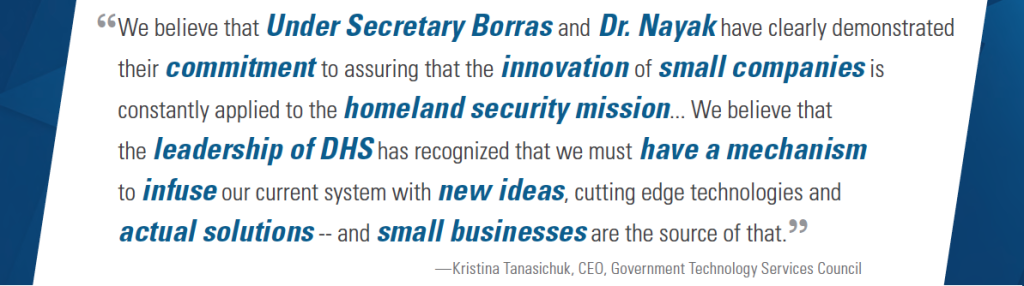
DHS’ Procurement Office released its 2012 Progress report on its priorities and accomplishments.  GTSC strongly recommends reading this report — it provides an excellent overview of the initiatives underway in the office and how DHS is working to standardize purchasing across the department where possible, advocating for small business and continuing to achieve small business contracting goals (p.12) and engage industry where appropriate and needed in the procurement process.


KT Quote


URGENT! INDUSTRY INPUT on Cyber requirements in procurement needed

In the latest major regulatory development on cybersecurity, a Working Group of the General Services Administration (GSA) and the Department of Defense (DoD), in consultation with the Department of Homeland Security (DHS) and the FAR Council, has invited the public to comment on what cybersecurity measures and parameters would be appropriate to be adopted in federal procurements. In a Request for Information (RFI) published on May 13 in the Federal Register, the Working Group advised it is accepting input until June 12, but in actuality input must be received by May 15 if it is going to be fully considered in the final report. The RFI provides a critical opportunity for industry to comment on potentially significant changes to cybersecurity requirements in federal acquisitions.

The Working Group is implementing requirements under Executive Order (EO) 13636. Much of the early focus on EO 13636 centered on the development of a voluntary cyber framework by the National Institute of Standards and Technology (NIST), which would then be implemented by the DHS. Indeed, much attention was paid to what incentives the DHS would utilize to encourage companies to adopt the voluntary cyber framework.

With so much focus on the framework, Section 8(e) of the Executive Order was almost lost in the noise.  Section 8(e) quietly but emphatically directed that within 120 days of the issuance of the EO, the GSA and the DoD, along with the DHS and the FAR Council, were to deliver recommendations on the feasibility, security benefits, and relative merits of incorporating security standards into acquisition planning and contract administration. The agencies would also recommend what steps can be taken to harmonize and make consistent existing procurement requirements related to cybersecurity. The GSA established the DoD-GSA Sec. 8(e) Working Group, which includes representatives from the DoD, the DHS, the Office of Federal Procurement Policy, and NIST.

The reality here is that government contractors MUST provide their input in a timely fashion to the Working Group, because the report and the recommendations will fundamentally alter government contracting for years to come. The cyber threat is real, present, and growing, and the federal government will not sit idly by and allow its contractors to conduct business without any meaningful cybersecurity requirements placed on them.

Thus, it will be vital for companies to submit their comments and do so in a way that recognizes the seismic changes occurring. As these cybersecurity requirements are implemented, they could alter a company’s business model, by:

  • Creating new grounds on which to determine whether a company’s proposal is technically acceptable;
  • Creating new bases to protest contracts pre and post award;
  • Creating increased requirements that, if breached, could lead to contract termination or even debarment; and
  • Fundamentally altering the financial resources that must be invested in order to be a government contractor in good standing.

Comments being solicited from industry are essentially broken down into three key areas:  1) Feasibility & Federal Acquisition – addressing the development of acquisition standards and evaluation criteria that should be incorporated into federal procurements; 2) Commercial Practices – addressing current commercial cybersecurity practices, policies, and procedures; and 3) Harmonization – addressing how to align federal cybersecurity standards with state, local, national, and international standards.

More specifically:

FEASIBILITY & FEDERAL ACQUISITION:  In general, the DoD and the GSA seek input about the feasibility of incorporating cybersecurity standards into federal acquisitions.

For example:

  1. What is the most feasible method to incorporate cybersecurity relevant standards in acquisition planning and contract administration? What are the cost and other resource implications for the federal acquisition system stakeholders?
  2. How can the federal acquisition system, given its inherent constraints and the current fiscal realities, best use incentives to increase cybersecurity amongst federal contractors and suppliers at all tiers? How can this be accomplished while minimizing barriers to entry to the federal market?
  3. What are the implications of imposing a set of cybersecurity baseline standards and implementing an associated accreditation program?
  4. How can cybersecurity be improved using standards in acquisition planning and contract administration?
  5. What are the greatest challenges in developing a cross-sector standards-based approach cybersecurity risk analysis and mitigation process for the federal acquisition system?
  6. What is the appropriate balance between the effectiveness and feasibility of implementing baseline security requirements for all businesses?
  7. How can the government increase cybersecurity in federal acquisitions while minimizing barriers to entry?
  8. Are there specific categories of acquisitions to which federal cybersecurity standards should (or should not) apply?
  9. Beyond the general duty to protect government information in federal contracts, what greater levels of security should be applied to which categories of federal acquisition or sectors of commerce?
  10. How can the federal government change its acquisition practices to ensure that the risk owner (typically the end user) makes the critical decisions about that risk throughout the acquisition life cycle?
  11. How do contract type (e.g., firm fixed price, time and materials, cost-plus, etc.) and source selection method (e.g., lowest price technically acceptable, best value, etc.) affect your organization’s cybersecurity risk definition and assessment in federal acquisitions?
  12. How would you recommend the government evaluate the risk from companies, products, or services that do not comply with cybersecurity standards?


COMMERCIAL PRACTICES:  In general, the DoD and the GSA seek information about commercial procurement practices related to cybersecurity.

For example:

  1. To what extent do any commonly used commercial standards fulfill federal requirements for your sector?
  2. Is there a widely accepted risk analysis framework that is used within your sector that the federal acquisition community could adapt to help determine which acquisitions should include the requirement to apply cybersecurity standards?
  3. Describe your organization’s policies and procedures for governing cybersecurity risk.  How does senior management communicate and oversee these policies and procedures? How has this affected your organization’s procurement activities?
  4. Does your organization use “preferred” or “authorized” suppliers to address cybersecurity risk? How are the suppliers identified and utilized?
  5. What tools are you using to brief cybersecurity risks in procurement to your organization’s management?
  6. What performance metrics and goals do organizations adopt to ensure their ability to manage cybersecurity risk in procurement and maintain the ability to provide essential services?
  7. Is your organization a preferred supplier to any customers that require adherence to cybersecurity standards for procurement? What are the requirements to obtain preferred supplier status with this customer?
  8. What procedures or assessments does your organization have in place to vet and approve vendors from the perspective of cybersecurity risk?
  9. How does your organization handle and address cybersecurity incidents that occur in procurements? Do you aggregate this information for future use? How do you use it?
  10. What mechanisms does your organization have in place for the secure exchange of information and data in procurements?
  11. Does your organization have a procurement policy for the disposal of hardware and software?
  12. How does your organization address new and emerging threats or risks in procurement for private sector commercial transactions? Is this process the same or different when performing a federal contract? Explain.
  13. Within your organization’s corporate governance structure, where is cyber risk management located (e.g., CIO, CFO, Risk Executive)?
  14. If applicable, does your Corporate Audit/Risk Committee examine retained risks from cyber threats and implement special controls to mitigate those retained risks?
  15. Are losses from cyber risks and breaches treated as a cost of doing business?
  16. Does your organization have evidence of a common set of information security standards (e.g., written guidelines, operating manuals, etc.)?
  17. Does your organization disclose vulnerabilities in your products/services to your customers as soon as they become known? Why or why not?
  18. Does your organization have track-and-trace capabilities and/or the means to establish the provenance of products/services throughout your supply chain?
  19. What testing and validation practices does your organization currently use to ensure security and reliability of products it purchases?


HARMONIZATION: In general, the DoD and the GSA seek information about any conflicts in statutes, regulations, policies, practices, contractual terms and conditions, or acquisition processes affecting federal acquisition requirements practices related to cybersecurity and how the federal government might address those conflicts.

For example:

  1. What cybersecurity requirements that affect procurement in the United States (e.g., local, state, national, and other) has your organization encountered? What are the conflicts in these requirements, if any? How can any such conflicts best be harmonized or de-conflicted?
  2. What role, in your organization’s view, should national/international standards organizations play in cybersecurity in federal acquisitions?
  3. What cybersecurity requirements that affect your organization’s procurement activities outside of the United States (e.g., local, state, national, and other) has your organization encountered? What are the conflicts in these requirements, if any? How can any such conflicts best be harmonized or de-conflicted with current or new requirements in the United States?
  4. Are you required by the terms of contracts with federal agencies to comply with unnecessarily duplicative or conflicting cybersecurity requirements? Please provide details.
  5. What policies, practices, or other acquisition processes should the federal government change in order to achieve cybersecurity in federal acquisitions?
  6. Has your organization recognized competing interests amongst procurement security standards in the private sector? How has your company reconciled these competing or conflicting standards?

At the end of the day, cybersecurity requirements are inevitable. Even if the Working Group moves slowly in implementing recommendations, Congress has shown a willingness to act independently and decisively on new procurement rules. Thus, contractors need to move quickly and decisively to submit comments by May 15, and they should work closely with their procurement counsel to determine what recommendations from the Working Group would be the least burdensome while effectively adding to the federal government’s cybersecurity posture. Failure to do both will mean a narrow window of opportunity will be missed, and much scrambling will have to be done in order to meet potentially unrealistic or irrelevant cybersecurity measures.

Brian Finch


Brian Finch is GTSC’s Strategic Partner and a partner at Dickstein Shapiro LLP, where he leads the Global Security practice.  He can be reached at[email protected] or 202-420-4823.


SIA 2013 Government Summit

Our strategic partner, the Security Industry Association (SIA), will hold its annual Government Summit in Washington, DC on June 4-5 at the W hotel. GTSC’s CEO, Kristina Tanasichuk, will be moderating one of the panels.

The Summit brings together all levels of the security industry: executives, integrators, sales, marketing and government relations professionals. The sessions are geared towards doing business with government (state and federal), identifying the trends facing the industry, and understanding how policy drives business.

The Summit kicks off on Monday, June 3, with an informal welcome reception in the POV Lounge at the W Hotel. This event will be attended by elected officials, administration personnel, Congressional staff, members of the media and some surprise guests. Summit participants will have the opportunity to network with their industry colleagues as well as speakers, all while taking in panoramic views of our nation’s capital.

On Tuesday, June 4, the Summit begins with panels covering Emerging Technologies and Governance; Identity, Cybersecurity and Privacy; Government Purchasing; Protecting Transportation as Critical Infrastructure; Greening of the Industry and Market Drivers in the Government Space.

Tuesday evening, June 4, the Summit moves to the Hamilton Live for the annual Policy Dinner, which features another reception, a short awards program and dinner. The policy dinner keynote speaker is Pulitzer-Prize winning journalist and best-selling author Bob Woodward. Participants will have an opportunity to meet Mr. Woodward one-on-one.

Attendees will also be hearing from Connecticut Governor Dannel Malloy, who will give a keynote address on school safety and security.

Wednesday’s half-day session will focus on school safety and security with keynote addresses expected from leading policymakers, which will be followed by a panel on school safety. The complete program and registration information can be found at SIA Government Summit. The conference is capped at 200 participants, so register soon!

U.S. Sentencing Guideline Recommendations Submitted to Congress

Here is an announcement from Victoria Espinel, the U.S. Intellectual Property Enforcement Coordinator, in the Executive Office of the President

I’m pleased to report that the United States Sentencing Commission submitted to Congress amendments to the federal sentencing guidelines to add new sentencing enhancements for intellectual property-related crimes. Three of these amendments reflect changes called for by the Administration’s March 2011 White Paper on Intellectual Property Enforcement Legislative Recommendations and the Administration’s letter to the U.S. Sentencing Commission can be found here. The proposed Sentencing Guidelines provide for:

  • Enhancements to offense levels for trade secret and economic espionage crimes by individuals who steal trade secrets knowing they will be transferred outside of the United States, or who intend the theft to benefit a foreign government;
  • Enhancements for trafficking in counterfeit drugs, which can result harm to public health and safety; and
  • Enhancements for offenses involving counterfeit military goods and services that jeopardize the safety of United States troops and compromise mission effectiveness.

The amendments will go into effect on November 1, 2013, unless Congress acts to modify or disapprove them. More information on the amendments promulgated may be found on the Commission’s website at www.ussc.gov.


June 6: Market Solutions Series: Focus on Joint Ventures

The current Federal environment requires creativity, drive and passion to succeed. Part of this creativity manifests itself in the strategies your company employs to continue its growth or maintain its current position. A number of CEOs have asked GTSC about joint ventures — why you would choose to form one, how they are formed, the different types and the legal considerations.

Join GTSC on Thursday, June 6 to hear from several small businesses that formed joint ventures and engage with them to learn how they did it, why, and whether or not they would do it again. Also, hear from some of the leading industry experts on the legal and operational considerations to consider in setting up your joint venture.
About the GTSC Market Solutions Series
The Market Solutions Series provides an inside look at creative successful interactions in the Federal homeland and national security market. These intimate roundtables take members inside the “story” and allow them to understand the market components and forces that resulted in success. The Market Solution Series was developed in response to members who were interested in creative ways to partner and team to win business with the Federal government.

Miss the session? Check out the slides here!

About our speakers:

LeapFrog Solutions Logo


Lisa Martin Headshot

Lisa Martin

CEO, LeapFrog Solutions

Areas of Focus: creative impact, brand and identity, digital, public engagement, program management and recruitment campaigns

As founder and CEO of LeapFrog Solutions, Ms. Martin wears many hats. Her vision for starting LeapFrog Solutions was to help her clients “leapfrog” their competition by making their message matter online and offline to improve their bottom line. Her collaborative nature permeates throughout the company and is demonstrated by her team’s innovative approach to integrating traditional marketing communications with emerging technologies.

Beyond running a successful marketing communications management firm, Lisa is a certified yoga instructor and scuba diver – although she’s never tried to combine both activities at the same time. She wanted to be a marine biologist when she grew up until she realized she was afraid of dark water. Lisa and her husband Jean-Paul, an accomplished triathlete, and their two daughters, Charlotte and Dominique, enjoy their annual trips to France to visit family. >>Read More

Bluewater federal

Brian Nault Headshot

Brian Nault

President, BlueWater Federal Solutions, Inc.

Areas of Focus: program management, IT service delivery, software development and cybersecurity

Mr. Nault is a proven executive with over 27 years of experience in the fields of financial services, technology and Federal Government contracting. He has a strong background in corporate operations, information technology, and finance that is now being applied to National Security and Civilian Programs.

Prior to his tenure at BlueWater, Mr. Nault worked at American Operations Corporation (AOC) as a Senior Vice President, providing strategic planning and technical and business solutions. Preceding that Mr. Nault spent over 17 years at Ford Motor Company where he held a number of positions in operations, finance and executive management at the Ford Credit subsidiary.

Mr. Nault has been with BlueWater since its founding in 2005, holds a BS degree from the University of Southern Maine and in addition to his family and BlueWater, Mr. Nault maintains a passion for the “Nation’s future”— our youth. He is involved with several children’s charities, including St. Judes Children’s Hospital and the Redskins Foundation. Additionally, he supports high school scholarships and non-profit scholastic organizations. >>Read More

Devon HewittDevon E. Hewitt

Member, Protorae Law PLLC

Areas of Focus: Government Contracts, Business Litigation, Bid Protests

Devon Hewitt has over 20 years experience in the field of government contracts, representing small, mid-tier and large government contractors. She advises clients on a wide range of government contracting issues including  FAR compliance; small business contracting programs; intellectual property and data rights; GSA Schedule; the Service Contract Act; noncompete, nonsolicitation and nondisclosure agreements; subcontracts and teaming arrangements; joint ventures; FOIA; due diligence and novations; contract claims; business ethics and the mandatory disclosure rule; suspension and debarment; terminations and government audits and investigations.   Ms. Hewitt also is a litigator and has represented clients in nearly 100 protests before federal agencies, the U.S. Court of Federal Claims, and the Government Accountability Office.  She is one of the few attorneys has that argued bid protest appeals before the United States Court of Appeals for the Federal Circuit.  In addition, Ms. Hewitt represents clients in subcontract and other dispute matters in civil courts and in arbitrations.  Prior to joining Protorae Law, Ms. Hewitt was a Partner at Piliero Mazza in DC and a Partner in the Government Contracts practice of Pillsbury, one of the largest law firms in the country.

Ms. Hewitt has been recognized for her work assisting veteran-owned companies in receiving verification from the Department of Veterans Affairs.  She has served on the American Legion’s Small Business Task Force, was a featured speaker at the American Legion’s annual convention and was the only attorney that participated in a closed-door meeting with Tom Leney regarding revision of the VA’s verification regulations. Bloomberg News regularly seeks comments from and cites Ms. Hewitt in articles on veteran-owned business matters. >>Read More

dickstein-shapiro-280x106


T. Malcolm SandilandsT. Malcom Sandilands

Partner, Dickstein Shapiro LLP

Malcolm Sandilands is a partner in Dickstein Shapiro’s Corporate & Finance Group. He represents private and public corporations, hedge funds, private equity funds, venture capital operating companies (VCOCs), and business development companies (BDCs) in investments, acquisitions, portfolio management, and sales. Prior to joining Dickstein Shapiro, Mr. Sandilands was a partner at Bingham McCutchen. Mr. Sandilands is admitted to practice in Massachusetts and the District of Columbia. He is a member of the American Bar Association. Mr. Sandilands graduated from the University of Michigan Law School (J.D., 1989) and from the University of Oxford, New College (B.A., 1986). >>Read More

Register now

May 10: Insight Session with Dr. Daniel Gerstein, Deputy Under Secretary, S&T, DHS

Join the Government Technology & Services Coalition for an Insight Session with Dr. Daniel Gerstein, Deputy Under Secretary for Science & Technology (S&T) at the U.S. Department of Homeland Security (DHS). He will discuss the structure of S&T, how it engages small and emerging companies in the S&T process and share talk about S&T’s priorities for 2013 and 2014.

Register now

daniel gersteinAbout Dr. Gerstein

Dr. Daniel M. Gerstein has served as the Deputy Under Secretary for Science & Technology in the Department of Homeland Security since August 2011. He is also an Adjunct Professor at American University in Washington, DC at the School of International Service (SIS) where he teaches graduate level courses on biological warfare and the evolution of military thought.

Dr. Gerstein has extensive experience in the security and defense sectors in a variety of positions while serving as a Senior Executive Service (SES) government civilian, in uniform, and in industry. Before joining DHS, he served as the Principal Director for Countering Weapons of Mass

Destruction (WMD) within the Office of the Secretary of Defense (Policy). He has served on four different continents participating in homeland security and counterterrorism, peacekeeping, humanitarian assistance, and combat in addition to serving for over a decade in the Pentagon in various high level staff assignments. Following retirement from active duty, Dr. Gerstein joined L-3 Communications as Vice President for Homeland Security Services, leading an organization providing WMD preparedness and response, critical infrastructure security, emergency response capacity, and exercise support to U.S. and international customers.

Dr. Gerstein also has extensive experience in international negotiations having served on the Holbrooke Delegation that negotiated the peace settlement in Bosnia, developed and analyzed negotiating positions for the Conventional Armed Forces in Europe (CFE) talks, and developed an initiative to improve cross border communications between Colombia and neighboring Andean Ridge nations. Additionally, Dr. Gerstein led an initiative to develop a comprehensive biosurveillance system for the Department of Defense (2010-2011), served on the leadership team for the Project for National Security Reform (PNSR) which was charged with developing a new national security act to reflect the changing security environment (2007-2008), co-led the Secretary of the Army’s Transition Team (2004-2005), and led the Army’s most comprehensive restructuring since World War II (2000-2001).

He has been awarded numerous military and civilian awards including an award from the Government of Colombia, the Department of State’s Distinguished Service Award, and the U.S. Army Soldiers Medal for heroism.

He has published numerous books and articles on national security, biological warfare, and information technology including Bioterror in the 21st Century (Naval Institute Press, October 2009), ICMA Report: Planning for a Pandemic (ICMA Press, Volume 39/Number 3 2007), Securing America’s Future: National Strategy in the Information Age (Praeger Security International, September 2005); Leading at the Speed of Light (Potomac Books, November 2006); Assignment Pentagon (Potomac Books, May 2007). He has also served as a fellow at the Council on Foreign Relations and is a current member.

Dr. Gerstein graduated from the United States Military Academy at West Point and has masters degrees from Georgia Institute of Technology in Operations Research, the National Defense University in National Security & Strategic Studies and the Command & General Staff College in National Security Strategy & Policy, and a Doctor of Philosophy degree from George Mason University in Biodefense.

He resides in Alexandria, VA with his wife Kathy. They have two daughters.

May 20: Mentor Session with L-3 Communications Security & Detection Systems

Join L-3 Communications Security & Detection Systems’ Ellen Howe and GTSC for a Mentor Session on May 20, 2013. L3 Communications Security & Detection Systems is wholly owned by L-3 Communications and is the leading supplier of security detection systems. Their solutions focus is on CheckpointChecked BaggageAir Cargo, and Cargo at Airports & Transportation Centers, Ports and Borders, Secure Government and Commercial Facilities, and Events. L-3 Communications Security & Detection Systems is also a broad technology innovator and integrator with computed tomography, automated, conventional and high-energy X-ray, active millimeter wave (MMW), energetic materials detection, networking and interconnectivity. They are a market leader with a worldwide installed base of over 50,000 security systems and active systems in 9 of the world’s top 10 airports. They have been globally recognized for outstanding maintenance and service support.

GTSC’s mentor companies work with the small and mid-sized companies in the Coalition to partner and bring the innovation, ideas and agility of small business to the experience, infrastructure and resources of large companies. GTSC mentors join us to provide advice and counsel on the convergence of homeland and national security, find new and innovative teaming partners, address challenges in the prime/subcontractor relationship in a neutral environment and improve mentor/protégé communication and success. Both our large and small companies recognize that the best security for our citizens – both physically and economically – is derived from the ability of our markets to meet the challenges posed by terrorism, natural disasters, and criminal activity.

Ellen Howe
Director of Business Development             

L-3 Communications Security & Dectection Systems

Ellen Howe is Director of Business Development for L-3 Communications Security & Detection Systems. Ms. Howe is responsible for managing strategic relationships and expanding business in the U.S. Federal Civilian sector including Homeland Security.  She also leads efforts expanding the global air cargo security market.

Ms. Howe served the U.S. Department of Homeland Security at the Transportation Security Administration (TSA) as Assistant Administrator for Strategic Communications and Public Affairs from 2006 until 2009.  She guided the Federal agency as part of the senior leadership team and served as chief communications strategist. Ms. Howe’s was a senior spokesperson and she appeared on many news programs including the Today Show and the Fox Report. Ms. Howe branded TSA’s tagline seen in airports “Your safety is our priority” and shifted the department’s energies from reactive to strategic by highlighting initiatives including workforce improvements, technology innovations and security enhancements. During her tenure TSA launched the groundbreaking TSA blog and a successful public awareness campaign in partnership with the Ad Council.

Register now